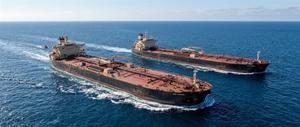
Frontline Plc is a leading provider of crude oil tanker transportation services, specializing in the maritime transportation of crude oil and refined petroleum products. The company operates a modern fleet of tankers, focusing on providing safe, efficient, and reliable shipping solutions to its clients, primarily in the oil industry. With a strategic emphasis on maintaining high operational standards and environmental compliance, Frontline ensures that its vessels are equipped with the latest technology and adhere to international regulations, making it a key player in the global oil transportation market. Through its commitment to quality and performance, Frontline aims to meet the evolving needs of its customers while navigating the complexities of the maritime shipping industry. Read More
Frontline (NYSE:FRO) reported its highest quarterly profit and adjusted profit on record for the second quarter of 2026, supported by sharply higher tanker rates and market inefficiencies that management said have tightened effective vessel supply.
The company posted net income of $659.2 million, o
Three stocks are benefiting from the same geopolitical crisis, but their risks are radically different. Discover which opportunities could endure and which may unravel when conditions change.
Frontline, Euroseas, and Nordic American Tankers raised dividends in 2026, with Frontline boosting its payout 50% after reporting its highest quarterly profit since 2004.
Frontline (NYSE:FRO) reported what Chief Executive Officer Lars Barstad called the company’s most profitable quarter since 2004, as tanker markets were reshaped by the effective closure of the Strait of Hormuz and shifting global oil trade patterns.
Speaking on the company’s first-quarter 2026 earn
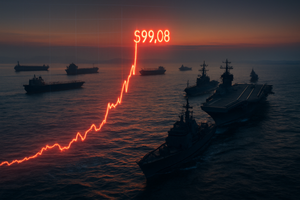
The global energy landscape was thrust into a state of acute crisis this week as West Texas Intermediate (WTI) crude oil prices surged to $99 per barrel, following a United States-led naval blockade of the Strait of Hormuz. The blockade, a dramatic escalation in the ongoing "2026 Iran War," has
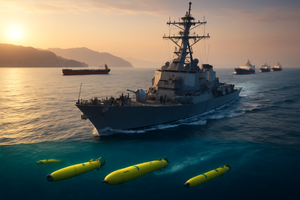
MANAMA, Bahrain — In a high-stakes display of maritime power, the U.S. Navy successfully completed a series of intensive mine-clearing operations in the Strait of Hormuz between April 11 and April 14, 2026. Deploying a sophisticated fleet of Arleigh Burke-class destroyers alongside unmanned underwater vehicles, the mission aimed to neutralize
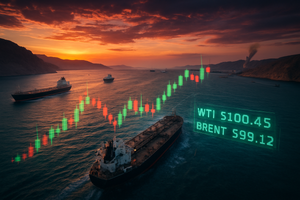
The global energy market witnessed a surprising reversal on Tuesday as oil prices retreated below the psychological $100-per-barrel mark. Brent crude, the international benchmark, fell to $98.76, while West Texas Intermediate (WTI) slipped to $96.72. This downward movement comes despite the escalating military situation in the Middle East,
The International Energy Agency (IEA) has issued its most dire warning in its 52-year history, declaring that the current energy crisis triggered by the escalating conflict with Iran is more severe than the oil shocks of 1973, 1979, and 2022 combined. Speaking from an emergency briefing in Paris on April
TEHRAN/NEW YORK — As the second quarter of 2026 begins, the global energy market is grappling with an unprecedented crisis in the Strait of Hormuz. Following the outbreak of the "2026 Iran War" in late February, the Iranian government has effectively transformed one of the world's most critical maritime corridors
As of April 10, 2026, the global energy landscape remains on a knife-edge. Despite a tenuous, Pakistani-brokered ceasefire aimed at halting the direct kinetic exchange between Washington and Tehran, energy markets have refused to retreat to pre-conflict levels. West Texas Intermediate (WTI) crude continues to trade stubbornly above the $100
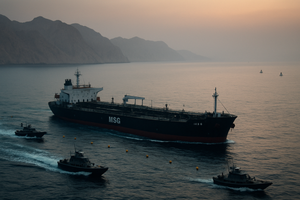
BANDAR ABBAS, Iran – In a move watched closely by global energy markets and maritime security experts, the Gabon-flagged tanker MSG (IMO 9466623) successfully navigated the Strait of Hormuz on Thursday, April 9, 2026. The transit marks the first time a non-Iranian commercial vessel has traversed the world’s most vital
In a dramatic shift that has sent shockwaves through global financial centers, the United States and Iran have entered a fragile two-week ceasefire, effective immediately. The truce, brokered through intense back-channel diplomacy by Pakistan, aims to de-escalate a 40-day conflict that had brought the world’s energy markets to the
As the world watches the escalating conflict in the Middle East, a high-stakes diplomatic ballet is unfolding between Washington and Beijing. With the current date of April 9, 2026, marking six weeks since the commencement of "Operation Epic Fury," the geopolitical landscape has shifted dramatically. The upcoming summit between President